Gluten-free beer… How does that work?
If you’re looking for gluten free beers you’re in the right place. At Brass Castle Brewery all our beers are certified gluten free.
Every batch is checked and certified gluten-free by a third party laboratory, on an individual batch rather than brand basis. Each batch achieves its own certificate to declare it gluten-free. You can be confident therefore that if it is a Brass Castle beer then it has met the Gluten-Free standard. But what is that standard exactly?
Check out our full gluten free beer range here!
BIT OF HISTORY/HERE COMES THE SCIENCE
In the UK and Europe (and indeed most of the rest of the world, except the USA), the United Nations (UN) ‘Codex Alimentarius’ (‘Food Code’ - established in 1963 to protect consumer health) sets the standard for what may be labelled ‘Gluten-Free’.
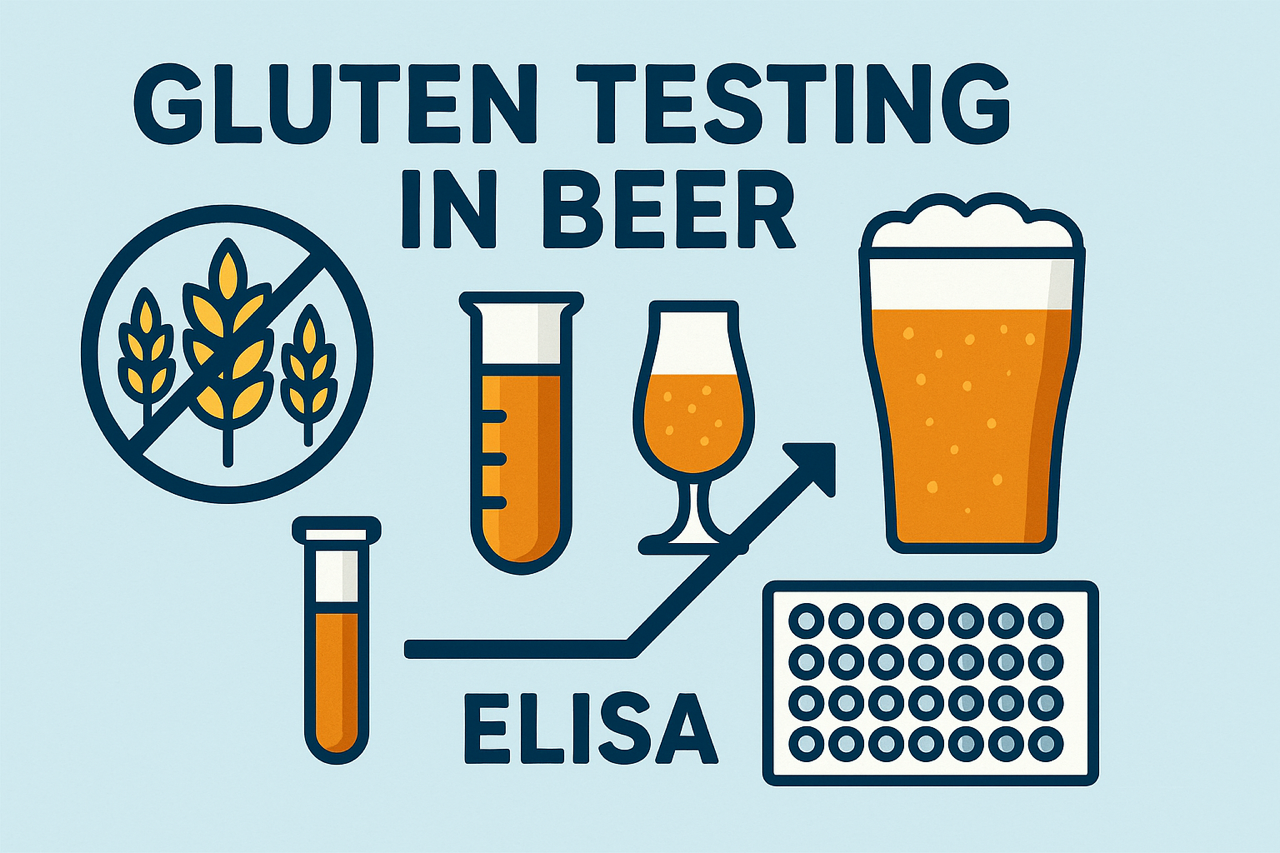
The UN proclaimed some time ago that an individual with any grade of gluten-intolerance can safely ingest foodstuffs than contain fewer than 20ppm (parts per million) of gluten and that an acceptable laboratory test for the presence of gluten is an ELISA (Enzyme-Linked Immunosorbent Assay) test. Since that determination, the US Food and Drug Administration became concerned that a basic ELISA test (sometimes referred to as a ‘sandwich’ test) may not accurately record gluten-content, particularly in respect of hydrolised gluten in drinks/alcoholic beverages.
To date the US deems a foodstuff (or drink) to only be considered gluten-free if no gluten-containing ingredients are involved in its preparation. Interestingly, this means that foodstuffs marked ‘Gluten-Free’ in the US do not have to be subjected to any testing - when it is perfectly possible that gluten may enter into the food production process in many ways and at many points besides being present in an ingredient.
The modern laboratory standard test for hydrolised gluten is called a ‘competitive’ ELISA, and it is a significant upgrade over the earlier protocols. It is widely deemed to be very accurate in the detection of gluten, which is why everybody but the USA uses it to determine the gluten-free status of beer. This laboratory test is relatively inexpensive and so is the one used by most breweries to get a gluten-level read.
Some breweries however, may only test one batch of a particular product annually and consider that sufficient due diligence done for the year - something that (as with the US approach) seems to us to admit the unacceptable possibility of a production error or oversight leading to change in product gluten content within other batches.
So, ‘Gluten-Free’ does not mean that a beer is entirely free of gluten but it does mean that we guarantee fewer than 20ppm, making it safe to drink for persons with a gluten intolerance.
THE BRASS CASTLE APPROACH
Our view is that good beer should be available to everyone to enjoy, and that following a vegan/vegetarian diet or avoiding gluten should not stand in the way of that.
At Brass Castle we send a sample from every batch of beer that we make to a laboratory for gluten-testing. It is important for us that we can be sure a beer labelled ‘gluten-free’ is precisely and safely that. The laboratory that we use can achieve a maximum accuracy level that allows them to say that a food product has <10ppm gluten and we only accept that as our benchmark to market the beer - since that measure ensures that we have a good safety margin on the <20ppm gluten-free standard.
CAN A BEER BE GLUTEN FREE AND ALCOHOL FREE?
Yes! We pride ourselves on brewing any and every style of beer but doing it gluten-free, that includes our gluten free and alcohol-free beer Life's AF Beach. We’re also working on bringing more exciting non alcoholic gluten free beers to the Brass Castle range, so keep an eye out for these.
HOW IS OUR GLUTEN FREE BEER MADE?
Our aim is always to offer the widest selection of gluten-free beers and beer types in one place. To do this we think carefully about recipe formulation but by-and-large all our beers begin with very standard ingredients. That includes gluten-bearing ingredients such as malted barley and wheat.
During the brewing process we use naturally-derived products to remove gluten from the beer, so some people refer to our style of beer as ‘gluten-removed’. Almost every brewery uses a seaweed derivative during wort boiling on brewday for instance, to help remove proteins (including gluten) that potentially cause haze in a finished beer.
We do the same, and that is our first process step in reducing a beer’s gluten level. If we did nothing else then our beer gluten content would be close to the gluten-free standard for most beer styles (regular beers are usually around 18-23ppm gluten) but would certainly not be safely within it. Other beer styles that are known for their hazy appearance, such as weizens, witbiers or New England IPAs would still likely test at around 70-90ppm gluten by this stage.
The second adjustment we make is to add a mould-derived enzyme during fermentation. As fermentation occurs, the developing beer churns and mixes in its tanks. The enzyme we add helps to draw gluten from the beer and remove it from suspension in the liquid. Gluten then drops to the bottom of the fermentation tank and we remove it. This is the key difference in gluten-free brewing that helps guarantee we can achieve our <10ppm target.
All of this means that it is slightly more costly to brew gluten-free beer. Conversely though, big lager companies have been brewing their beer using gluten-free brewing techniques for many years, because it has the added benefit of helping to clarify and brighten beer quickly - more cheaply than holding the same untreated beer in cold tanks for long periods to achieve the same clarity. Indeed, the technology that we now use to remove gluten from Brass Castle beers was principally developed by multinational brewers to accelerate clarification.
We believe that the US concern about the efficacy of competitive ELISA testing is now out of date in the light of recent advances. However, we are fortunate to be based near the UK’s Food Evaluation and Research Agency (FERA) and they have mass spectrometers - a technology that is beyond the ability of most brewers to deploy, but is one that is recognised by everyone (including the US) as an accurate way to determine the gluten content of a foodstuff. We are curious souls and occasionally send samples to be tested by mass spectrometry and neither we, nor FERA, are surprised when the results are identical to competitive ELISA results.
HOW IS GLUTEN FREE BEER DIFFERENT?
In removing gluten from the beer we are taking away an element that contributes to the beer-drinking experience and so our challenge is to offset any sense that ‘something-is-missing’. We’ve proved that removing gluten has no impact on flavour impression but we do know that protein/gluten contributes to mouthfeel and it also has a significant effect on head formation and head retention. Most people judge a beer mainly by the way it looks and the benchmark look for a beer is usually set by the advertising of large brands: so a foamy head is a requirement.
Some drinkers will also tell us that it is important for them to see foam ‘lacing’ down the glass - spoiler alert: that effect has nothing to do with beer quality and is achieved by brewers adding more wheat to a recipe (which is cheaper and less flavoursome than the barley malt it replaces!). Isinglass (finings derived from fish swim bladders) that is added to casks by non-veggie-friendly brewers also have a role in helping to create a particularly creamy head, with the associated truth that those finings are therefore not ‘left-in-the-cask’ as some isinglass users claim. In fact, a recent study in the US showed that on average drinkers imbibed 0.4ml of isinglass per pint of dosed cask beer.
If we were to do nothing, then there is a possibility that a gluten-free beer could taste slightly less full than a gluten-carrying equivalent and that the head may not be as aesthetically pleasing. We have a number of techniques that we can use to address this, from formulating recipes to increase body, to adding hops and adjuncts that improve head retention.
FAQs
Why does your beer say that it is gluten-free when I can see that malted barley and wheat are in the ingredient list - and both of them contain gluten?
Our beer is independently certified gluten-free and it is also a labelling requirement for us to show what allergen-bearing ingredients our beers begin life with. We appreciate that this can be slightly confusing but our process is to brew with regular gluten-bearing ingredients, then remove the gluten and laboratory test the beer. Our beer is therefore ‘gluten-removed’. The crux is that it is possible for a beer to begin life with gluten-bearing ingredients and then for gluten to be removed.
I have a wheat intolerance. Do you have any beers that do not begin life with wheat as an ingredient?
Wheat is an ingredient in most of our beers, but it is not present in our Helles Lager Beowulf or in the occasional special like Fifty Shades of Ginger.