An old English word, a celebrated Yorkshire drinking tradition and a beer style ripe for rediscovery.
Few beer names have quite the character of Stingo. It sounds robust, faintly mischievous and unmistakably British. More importantly, it has a genuine history stretching back centuries.
The word was being used for strong beer by the 17th century. The Oxford English Dictionary’s historical record includes a reference to “a Cup of stingo” in a play dating from 1635. By the following century, the term had acquired particularly strong associations with Yorkshire: The Connoisseur recorded a reference to “the best Yorkshire stingo” in 1756. Yet Stingo was not exclusively Yorkshire’s preserve; historical records also refer to strong beers called Stingo brewed elsewhere in Britain. It is best understood as an old name for strong ale, with Yorkshire becoming its most enduring regional association.
One of its most celebrated landmarks was the Yorkshire Stingo public house in Marylebone, London, established by at least 1733. It became a gathering place for Yorkshire people in the capital, with pleasure gardens and annual May festivities. In 1808, a newspaper reported that more than 20,000 people attended the celebrations, drinking strong ale and participating in traditional games. The pub’s name offers a striking illustration of how closely the beer had become associated with Yorkshire identity.
What, then, was Stingo? The historical evidence does not establish a single recipe or precise specification. Rather, the name described strong ale, sometimes explicitly old or well-matured. Its character would have depended on the brewer, ingredients and treatment of the beer. The familiar modern image of a rich, warming ale with dark-fruit and caramel notes is a plausible expression of that tradition, but should not be mistaken for a definitive description of every historical Stingo.
Some brewers have also pointed to the possibility that ‘Stingo’ may also have referred to a desirable sourness or ‘sting in the tail’ to these strong aged beers. Indeed, there is some evidence that Stingo tracelled and was much admired in other jurisdictions and that Belgian brewers, for instance, were sometimes sent to Yorkshire to study the brewing processes that lend so much character to this style.
The style appears to have lost ground during the 20th century, perhaps going the way of many stronger beers during the two World Wars - the result of punitive duties, rationing and the need of the state to draw heavily upon its population for engagement in total war.
Today, Stingo offers a compelling alternative to the emphasis on freshness and immediate consumption that dominates much of the contemporary beer market. It invites a different approach: a strong ale with the substance to reward time, careful presentation and considered drinking.
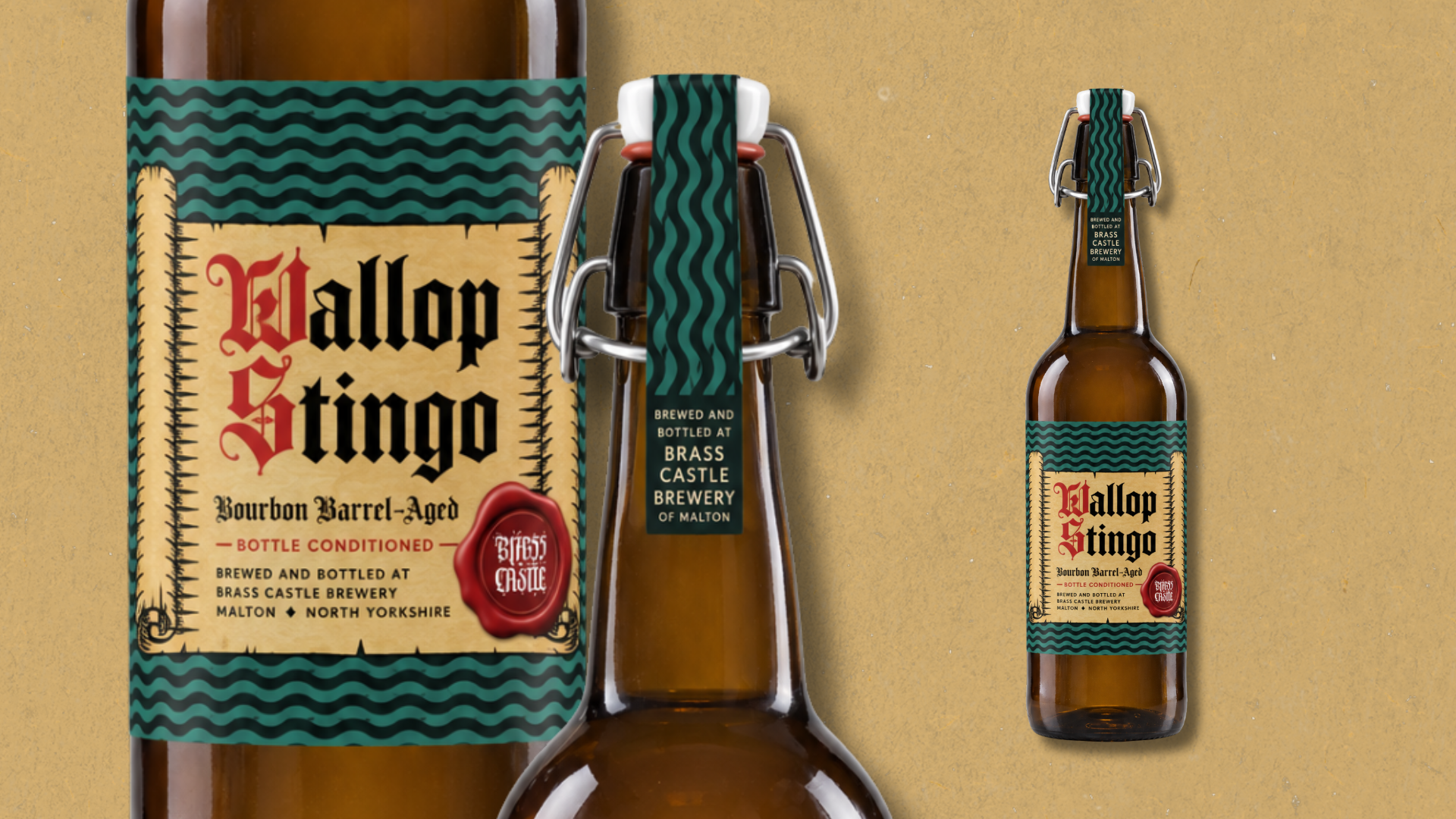
That tradition provides the inspiration for Brass Castle’s 8.4% Wallop Stingo. Presented in a 750ml bottle, it brings a historic name into a contemporary setting while recognising the special character of strong, bottle-worthy beer.
Brass Castle has brewed its Wallop Stingo frequently since 2013, with various barrel-aging programmes incorporating numerous flavour taints. Our current version was made, as usual, with the addition of black treacle for a light liquorice note. We have also been ageing it in former bourbon barrels. Overall, this has helped to develop flavours associated with oak, raisins, treacle toffee and Christmas pudding
The revival of Stingo is not simply an exercise in nostalgia. It is an opportunity to reconnect modern brewing with a part of Britain’s beer vocabulary that has survived in historical records, regional memory and a handful of enduring examples.
In Yorkshire, at least, the old word still has a sting in its tail.